For years, organizations have focused their cybersecurity strategies on protecting human users—employees, customers, contractors, and business partners. But today’s enterprise environment has evolved dramatically. Applications communicate with other applications; cloud services interact through APIs; bots automate repetitive tasks; and AI agents perform complex business operations without human intervention.
These digital entities are known as Non-Human Identities (NHIs), and they are growing at an unprecedented rate.
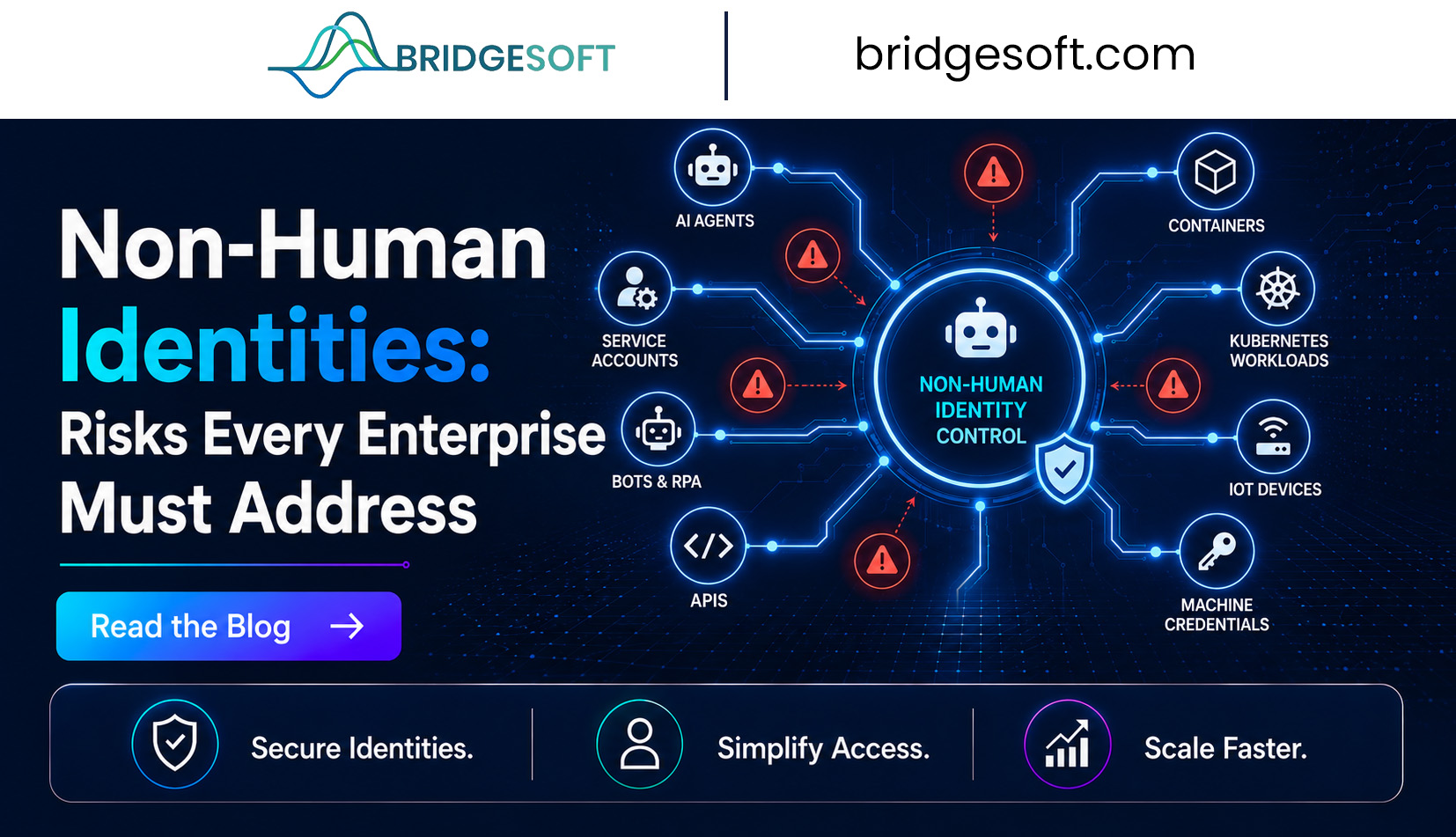
Non-human identities already outnumber human users by multiple times in many organizations. Service accounts, API keys, machine identities, containers, robotic process automation (RPA) bots, IoT devices, and AI agents all require access to business systems and sensitive data to perform their functions.
While these identities drive automation and innovation, they also introduce significant security risks if left unmanaged. Non-Human Identities, in contrast to human users, frequently operate silently in the background, making them challenging to monitor and control.
As enterprises continue to embrace cloud computing, DevOps, automation, and artificial intelligence, securing Non-Human Identities has become one of the most important priorities in modern Identity and Access Management.
What Are Non-Human Identities?
A Non-Human Identity is any digital identity that represents a machine, application, service, or automated process rather than a person.
Examples include:
- Service accounts
- Applications and microservices
- Cloud workloads and virtual machines
- Kubernetes containers
- DevOps pipelines
- Robotic Process Automation (RPA) bots
- AI agents and machine learning services
- Internet of Things (IoT) devices
These identities require authentication and authorization just like human users. They need access to databases, cloud resources, APIs, business applications, and enterprise infrastructure to perform automated tasks.
As organizations modernize their IT environments, the number of Non-Human Identities continues to grow exponentially.
In many enterprises, they now represent the largest group of identities within the organization.
Why Non-Human Identities Are Becoming a Major Security Risk
Unlike employee accounts, Non-Human Identities are often created automatically during application deployments, cloud provisioning, or software development processes.
Because they operate behind the scenes, organizations frequently overlook them.
Many service accounts remain active long after projects end. Applications may occasionally hardcode API credentials. Machine identities often receive excessive permissions simply because limiting access requires additional effort.
These practices create ideal opportunities for attackers.
A compromised API key or service account can provide cybercriminals with privileged access to critical infrastructure without triggering traditional security controls.
The challenge becomes even greater because Non-Human Identities rarely change passwords, frequently operate with elevated privileges, and often lack proper ownership or lifecycle management.
The result is a growing attack surface that many organizations struggle to detect.
The IAM Challenges Created by Non-Human Identities
As organizations scale cloud adoption and automation initiatives, traditional identity management approaches become increasingly difficult to apply.
One of the biggest IAM challenges is visibility.
Security teams often know how many employees they have but struggle to answer questions such as:
- How many service accounts exist?
- Which APIs have privileged access?
- Who owns each machine identity?
- Which credentials have never been rotated?
- Which automated processes still require access?
Without centralized visibility, organizations cannot effectively govern Non-Human Identities or assess the risks they introduce.
Another challenge is lifecycle management.
Unlike human users, machine identities may not follow standardized onboarding or offboarding processes. Many remain active indefinitely, increasing the likelihood of credential misuse or unauthorized access.
These IAM challenges become even more complex as organizations adopt multi-cloud environments, Kubernetes, AI platforms, and large-scale automation.
Why Identity Access Management Must Evolve
Traditional Identity Access Management was designed primarily to manage employees and business users.
Today’s identity ecosystem is fundamentally different.
Modern IAM strategies must provide equal visibility and governance for both human and Non-Human Identities.
Organizations need centralized identity platforms capable of discovering machine identities, monitoring their activities, enforcing least-privilege access, and continuously validating permissions.
Identity should no longer be viewed simply as a user directory—it must become the control layer for every digital entity operating within the enterprise.
By extending Identity and Access Management beyond human users, organizations can significantly reduce their attack surface while improving operational control.
Secure Access Management for Every Identity
One of the most effective ways to reduce the risks associated with Non-Human Identities is through robust Secure access management.
Every digital identity should receive only the minimum permissions required to perform its function.
Organizations should implement security practices such as:
- Centralized authentication for service accounts
- Least-privilege access policies
- Credential rotation and secret management
- Continuous monitoring of machine identity activities
- Automated access reviews
- Multi-cloud identity governance
- API authentication controls
Secure access management ensures that machine identities cannot access resources beyond their intended scope.
It also enables security teams to detect abnormal behavior, revoke unnecessary permissions, and reduce the risk of credential compromise.
As organizations increasingly rely on automation, Secure access management becomes essential for maintaining trust across digital ecosystems.
Preparing for an AI-Driven Future
Artificial Intelligence is accelerating the growth of Non-Human Identities faster than ever before.
AI agents now retrieve information, analyze data, execute workflows, interact with APIs, and make operational decisions autonomously.
Every AI model, intelligent assistant, and autonomous workflow introduces additional machine identities that require governance.
Without strong identity controls, AI systems could unintentionally access sensitive information, interact with unauthorized applications, or expose business-critical data.
Organizations preparing for AI adoption must treat Non-Human Identities with the same level of security as human users.
The future of cybersecurity will depend on securing not only people—but also every machine identity operating within the enterprise.
Conclusion
Non-Human Identities are no longer a niche technology concern—they have become one of the fastest-growing components of modern enterprise infrastructure.
As organizations embrace cloud computing, automation, APIs, and artificial intelligence, the number of machine identities will continue to rise. Without proper governance, these identities create significant security risks, operational challenges, and compliance concerns.
The future of enterprise security is not just about protecting users—it is about protecting every identity, human and non-human alike.
Ready to Secure Every Identity?
Discover how modern Identity Access Management solutions can help your organization discover, govern, and protect Non-Human Identities while strengthening Secure access management across your enterprise.
#Bridgesoft #NonHumanIdentities #IdentityAccessManagement #IAMChallenges #SecureAccessManagement #CyberSecurity #IdentitySecurity #MachineIdentity #CloudSecurity #APIManagement #DevSecOps #ZeroTrust #EnterpriseSecurity #DigitalTransformation #AI #Automation #IdentityGovernance #AccessManagement #ITSecurity #CyberResilience #FutureOfSecurity