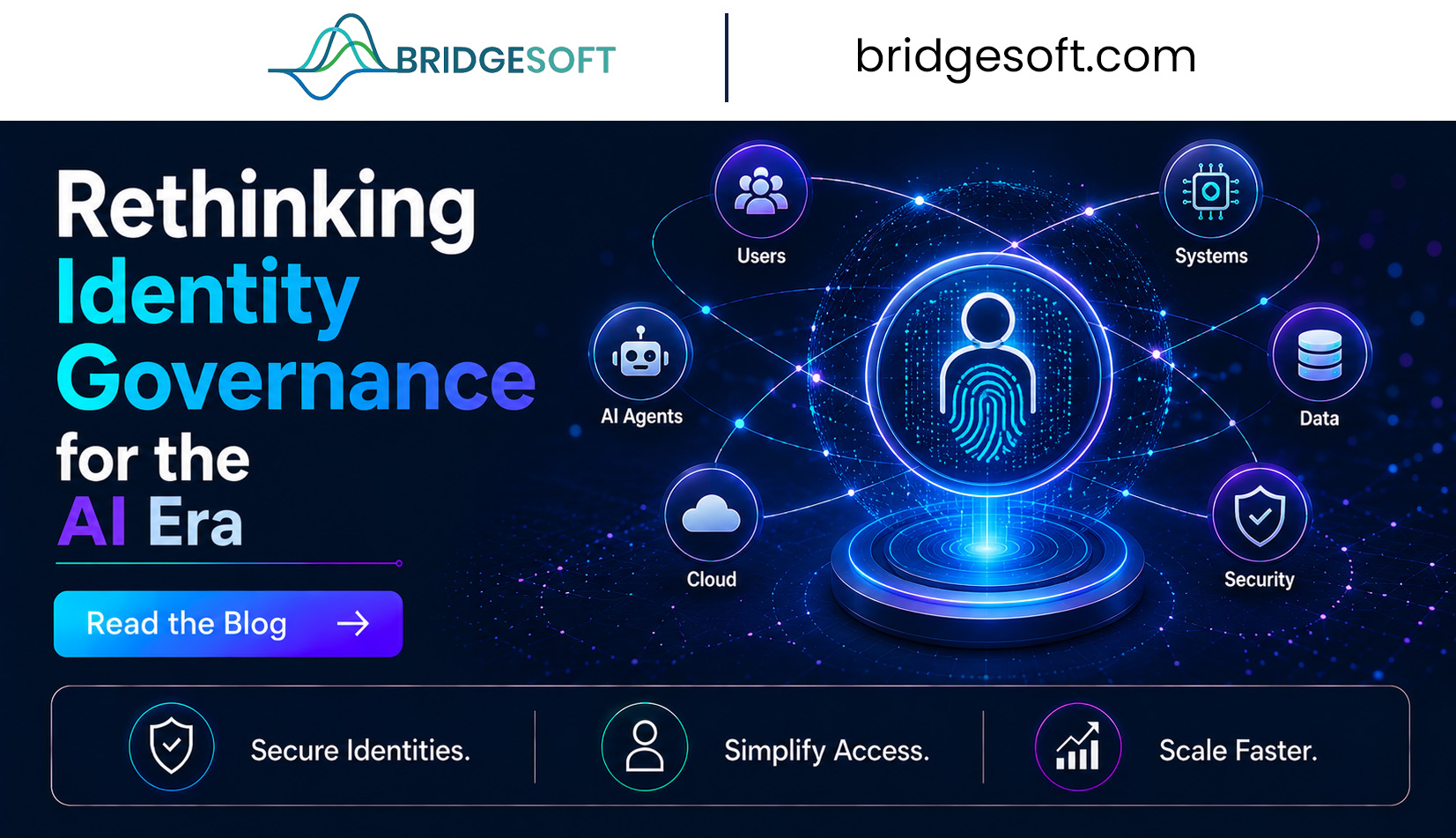
Artificial Intelligence is transforming enterprises faster than any previous wave of digital innovation. Intelligent systems are no longer limited to automating repetitive tasks—they are analyzing vast amounts of data, making recommendations, initiating workflows, and increasingly acting on behalf of employees. From AI-powered assistants and autonomous agents to machine learning platforms and intelligent automation tools, these systems are becoming an essential part of modern business operations.
For years, Identity Governance focused primarily on managing employee access, enforcing compliance, and controlling permissions across enterprise applications. While these responsibilities remain critical, today’s digital landscape introduces a much broader challenge. Organizations must now govern not only people, but also AI agents, machine identities, APIs, cloud workloads, and countless automated processes that interact with sensitive systems every second.
The age of intelligent systems demands a new approach to identity—one that is adaptive, automated, and capable of securing every identity across the enterprise.
[Non-Human Identities – Risks Every Enterprise Must Address]
The Identity Landscape Has Changed
The modern enterprise looks very different from what it did just a few years ago.
Employees now work across multiple cloud platforms, business applications are distributed across hybrid environments, APIs connect hundreds of services, and AI systems continuously exchange information with internal and external platforms. Alongside human users, organizations now manage Non-Human Identities, including service accounts, machine identities, robotic process automation (RPA) bots, and AI agents.
In many enterprises, these non-human identities already outnumber employees several times over.
Each identity—whether human or machine—requires access to applications, databases, cloud services, and business-critical information. Without centralized governance, organizations quickly lose visibility into who or what has access, why that access exists, and whether it is still appropriate.
For contemporary digital businesses, identity has evolved into the control plane.
Why Traditional Identity Governance Needs to Evolve
Conventional Identity Governance was designed around static user populations and relatively predictable business processes. Access reviews were periodic, user provisioning was often manual, and governance primarily focused on employees joining, changing roles, or leaving the organization.
Intelligent systems have fundamentally changed that model.
AI agents can make decisions in real time, automate business processes, and interact with multiple applications simultaneously. Machine identities may be created automatically as cloud workloads scale. APIs exchange data continuously across business ecosystems.
These identities operate around the clock and often without direct human interaction.
Manual governance procedures are no longer sufficient for organizations to manage settings that change every minute. Identity governance must become continuous, intelligent, and automated to match the pace of digital transformation.
Identity Governance Is the Foundation of Trusted AI
As enterprises adopt AI-powered solutions, trust becomes one of the most valuable business assets.
Customers, employees, and regulators all expect organizations to know exactly who—or what—is accessing sensitive information.
Modern governance enables organizations to discover identities, assign appropriate permissions, enforce policies, monitor activity, and continuously verify access. It creates accountability for every digital identity, whether it belongs to an employee, contractor, AI agent, or automated process.
Strong governance also supports regulatory compliance by providing complete visibility into identity activities and access decisions.
Without governance, AI innovation introduces uncertainty.
With governance, AI becomes a trusted business capability.
Identity Access Management Powers Intelligent Enterprises
While governance defines policies and oversight, Identity Access Management (IAM) ensures those policies are consistently enforced across the organization.
A modern IAM strategy enables organizations to authenticate users, authorize access, automate provisioning, and secure digital identities throughout their lifecycle.
As intelligent systems become more deeply integrated into enterprise operations, Identity Access Management extends beyond human users to include machine identities, APIs, cloud services, and AI agents.
This unified approach allows organizations to:
- Authenticate every identity.
- Apply least-privilege access.
- Automate provisioning and deprovisioning.
- Monitor identity activities continuously.
- Identify unusual activity before it turns into a security breach.
Identity Access Management establishes the operational framework that enables businesses to innovate safely while preserving visibility in ever more complex contexts.
Building AI-Ready Identity Governance
The future of Identity Governance and Administration (IGA) lies in intelligent automation.
Rather than relying solely on scheduled access reviews, organizations should continuously evaluate identities, permissions, and risks using real-time analytics and policy-driven automation.
An AI-ready governance strategy should include:
- Continuous identity discovery
- Automated access certification
- Identity Lifecycle Management
- Governance for Non-Human Identities
- Secure Access Management
- Privileged access monitoring
- Risk-based access decisions
- AI-driven anomaly detection
These capabilities help organizations reduce administrative effort while improving security, compliance, and operational efficiency.
The objective is not simply to govern identities—it is to govern them intelligently.
Preparing IAM Deployment for the Future
Many organizations are modernizing identity platforms as part of broader digital transformation initiatives. However, future-ready IAM Deployment strategies must be designed with intelligent systems in mind.
An AI-ready identity architecture should support:
- Human users
- AI agents
- Machine identities
- APIs
- Cloud-native applications
- Intelligent automation platforms
- Third-party ecosystems
Embedding identity controls early in IAM Deployment simplifies future integrations while ensuring governance remains consistent as organizations adopt new technologies.
Together with AI projects, identity planning lowers complexity and builds a more robust security base for long-term expansion.
Cloud IAM Security and Zero Trust
As enterprises increasingly rely on cloud platforms, identity becomes the primary security perimeter.
Strong Cloud IAM Security enables organizations to manage identities consistently across SaaS applications, hybrid infrastructure, and multi-cloud environments while maintaining centralized governance.
Combined with a Zero Trust security model, organizations continuously verify every user, device, application, and AI agent before granting access.
Instead of assuming trust based on network location, Zero Trust validates identity, context, and risk for every request.
This approach significantly reduces attack surfaces while supporting secure digital transformation.
In an AI-driven enterprise, Zero Trust begins with identity.
Conclusion
The rise of intelligent systems is redefining how organizations think about security. Identity Governance is no longer limited to managing employee access—it has become the foundation for securing AI agents, machine identities, cloud applications, and the expanding digital ecosystem.
The future belongs to enterprises that recognize a simple but powerful truth:
The organizations that govern every identity today will lead the intelligent enterprises of tomorrow.
Ready to Modernize Your Identity Governance Strategy?
As intelligent systems become central to business operations, your identity strategy must evolve with them. Bridgesoft helps organizations strengthen Identity Governance, modernize Identity Access Management, accelerate IAM Deployment, and implement secure, scalable governance for both human and non-human identities.
Discover how Bridgesoft can help you build an AI-ready identity security framework that enables innovation without compromising trust or security.
#Bridgesoft #IdentityGovernance #IdentityAccessManagement #IGA #IdentityLifecycleManagement #IAMDeployment #SecureAccessManagement #CloudIAMSecurity #NonHumanIdentities #MachineIdentities #AISecurity #AIGovernance #ZeroTrust #CyberSecurity #EnterpriseSecurity #DigitalTransformationSecurity #CloudSecurity #IdentitySecurity #AIInnovation #IdentityManagement