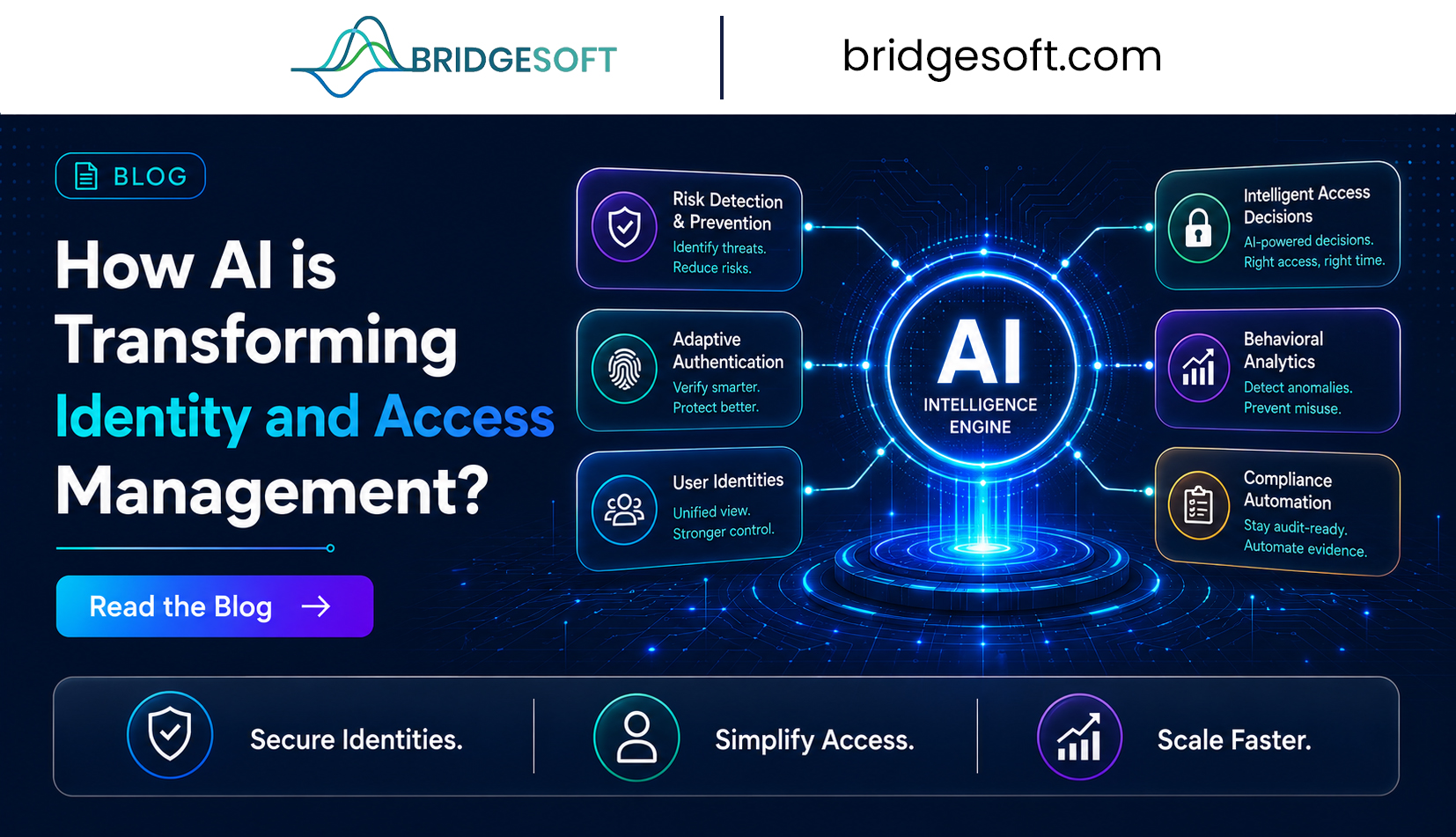
In today’s rapidly evolving digital landscape, organizations manage more identities, applications, devices, and access requests than ever before. The rise of cloud computing, remote work, SaaS adoption, and digital transformation initiatives has significantly increased the complexity of securing enterprise environments.
Traditional security models, built on static rules and manual processes, struggle to keep pace with modern threats. Cybercriminals continue to increase their sophistication. Identity is currently the primary attack vector, and security teams are continually trying to strike a balance between security and user experience.
This transformative shift is being driven by Artificial Intelligence (AI).
AI brings intelligence, automation, and predictive capabilities to Identity and Access Management (IAM). It helps organizations secure identities, automate routine tasks, detect threats quickly, and speed up deployment.
As businesses continue to modernize their security frameworks, AI-powered IAM solutions become essential for building resilient, scalable, and future-ready identity ecosystems.
The Growing Complexity of Modern Identity Management
Modern organizations manage thousands of employees, contractors, partners, customers, applications, and devices across cloud, on-premises, and hybrid environments. Users now expect seamless access from any location and device.
Traditional IAM systems often use predefined policies and require manual oversight. While these approaches served organizations well in the past, they no longer address today’s dynamic threat landscape.
Security teams face increasing challenges, such as:
- Managing large volumes of access requests
- Maintaining visibility across distributed environments
- Enforcing least-privilege access
- Detecting suspicious behavior in real time
- Meeting evolving compliance requirements
To address these challenges, organizations increasingly integrate AI into their Identity Access Management strategies.
How AI Benefits Identity Access Management
Through intelligent decision-making, AI is reshaping every phase of IAM. Automating procedures, enhancing threat detection, boosting Identity Gateway intelligence, and expediting IAM implementation are the four main ways that this change is most noticeable.
1. Automated IAM Processes and Smarter Operations
One of the most significant advantages of AI in IAM is its ability to automate complex and repetitive identity management tasks.
During IAM Implementation, organizations often spend substantial time managing user onboarding, offboarding, role assignments, access reviews, and policy enforcement. Manual handling of these activities can consume resources and lead to errors.
AI streamlines these operations by analyzing organizational structures, job roles, departments, and historical access patterns to automatically recommend appropriate permissions.
For example, when a new employee joins an organization, AI-powered systems suggest access rights based on similar users within the same department and role. This approach reduces administrative effort and keeps access policies consistent and compliant.
AI also improves governance by identifying:
- Unused permissions
- Excessive privileges
- Access anomalies
- Policy violations
Organizations may increase operational efficiency, enhance compliance, and greatly lessen the workload for IT and security personnel by automating these procedures.
2. Better Threat Detection Through Predictive Intelligence
Modern cyberattacks frequently target user identities and credentials. As a result, organizations need security solutions that detect threats before they escalate into major incidents.
AI enhances Identity Access Management by continuously analyzing user behavior, login patterns, device information, and contextual signals.
Unlike traditional systems that rely solely on predefined rules, AI learns normal user behavior over time and quickly identifies anomalies that may indicate compromised accounts or unauthorized access attempts.
For example, when an employee suddenly attempts to access sensitive resources from an unfamiliar country, on an unusual device, or at an unexpected time of day, AI detects the deviation and triggers additional security measures.
AI adds predictive intelligence to IAM methods, going beyond real-time monitoring to spot new threats before they materialize as security incidents.
AI can detect:
- Privilege escalation attempts
- Abnormal access requests
- Insider threat indicators
- High-risk user behavior patterns
- Potential account compromise
With this proactive approach, security teams can respond faster, cut false positives, and improve cyber resilience.
As identity becomes the new security perimeter, predictive intelligence plays a critical role in every successful IAM strategy.
3. Improved Identity Gateway Intelligence
The Identity Gateway serves as a critical control point between users and enterprise applications. It plays a central role in authentication, authorization, and access enforcement.
AI significantly increases the intelligence of modern Identity Gateway by introducing adaptive access controls and real-time risk assessment.
Rather than applying the same authentication requirements to every user, AI evaluates multiple contextual factors, including:
- User behavior
- Device health
- Geographic location
- Login history
- Access sensitivity
- Risk level
Based on these insights, the system dynamically adjusts authentication requirements.
For low-risk activities, users enjoy seamless access with minimal friction. For higher-risk situations, the Identity Gateway automatically enforces stronger security measures such as Multi-Factor Authentication (MFA), step-up authentication, or additional verification procedures.
This smart approach provides the best of both worlds:
- Enhanced security
- Improved user experience
- Reduced authentication fatigue
- Greater productivity
By making Identity Gateways smarter and more adaptive, organizations strengthen protection without creating unnecessary barriers for legitimate users.
[AI for Identity vs Identity for AI]
4. Faster and More Efficient IAM Deployment
As organizations embrace cloud-first and hybrid IT strategies, the demand for scalable and efficient IAM deployment models continues to grow.
Traditional deployment projects often require extensive planning, configuration, role engineering, and policy development. These activities delay implementation and increase project complexity.
AI accelerates IAM deployment by simplifying configuration processes and automating critical implementation tasks.
Modern AI-powered IAM platforms can:
- Recommend access policies
- Suggest role structures
- Analyze organizational hierarchies
- Identify deployment risks
- Optimize entitlement models
- Improve policy accuracy
AI also helps organizations integrate identities across diverse systems and environments more efficiently.
As a result, businesses deploy IAM solutions faster while maintaining strong governance, compliance, and security standards.
For organizations pursuing digital transformation initiatives, combining AI with IAM deployment creates a more agile and scalable foundation for growth.
The Future of AI-Driven Identity Security
The future of cybersecurity increasingly depends on intelligent identity management.
As organizations adopt more cloud applications, AI-powered tools, remote work models, and connected technologies, the volume and complexity of identity data will continue to grow.
Traditional approaches that rely heavily on manual intervention struggle to keep pace.
AI will continue evolving IAM capabilities through:
- Autonomous identity decisions
- Continuous risk evaluation
- Advanced behavioral analytics
- Predictive threat prevention
- Intelligent access governance
- Adaptive authentication models
Organizations that invest in AI-powered Identity Access Management today position themselves to defend against emerging threats, support digital transformation initiatives, and build resilient security frameworks for the future.
Conclusion
Artificial Intelligence is redefining Identity Access Management. Here are the four key takeaways:
- Automated IAM processes and smarter operations
- Better threat detection through predictive intelligence
- Improved Identity Gateway intelligence
- Faster and more efficient IAM deployment
These capabilities strengthen security, increase operational efficiency, and support growth.
As identity continues to serve as the foundation of modern cybersecurity, organizations must integrate AI into IAM strategies—making it a business necessity, not a future consideration.
Ready to Modernize Your Identity Security?
Discover how Bridgesoft AI-powered Identity Access Management solutions can strengthen security, streamline IAM Implementation, optimize your IAM Strategy, enhance Identity Gateway intelligence, and accelerate IAM Deployment across your organization.
#IdentityAccessManagement #IAMImplementation #IAMStrategy #IdentityGateway #IAMDeployment #ArtificialIntelligence #AISecurity #CyberSecurity #IdentityManagement #CloudSecurity #DigitalTransformation #ZeroTrust #EnterpriseSecurity #AccessManagement #IdentitySecurity #AIInnovation #FutureOfSecurity #BusinessTechnology #SecurityAutomation