Every organization wants employees to become productive from day one. Whether hiring a new employee, onboarding a contractor, or assigning additional responsibilities to an existing team member, timely access to business applications is essential. Yet, many IT departments still rely on manual processes to create accounts, assign permissions, and approve access requests.
At first glance, manual provisioning may appear manageable. However, as organizations grow, the number of users, applications, cloud services, and business systems increases rapidly. What once worked for a small IT team quickly becomes an operational bottleneck.
Manual User Access Provisioning slows onboarding, increases administrative workloads, creates inconsistent permissions, and exposes organizations to unnecessary security risks. Instead of focusing on strategic initiatives, IT teams spend valuable time responding to access requests, troubleshooting permissions, and managing account changes.
Modern businesses require a faster and more secure approach. This is where Identity and Access Management (IAM) transforms the provisioning process by automating access decisions and simplifying identity operations.
Why Manual Provisioning Becomes a Challenge
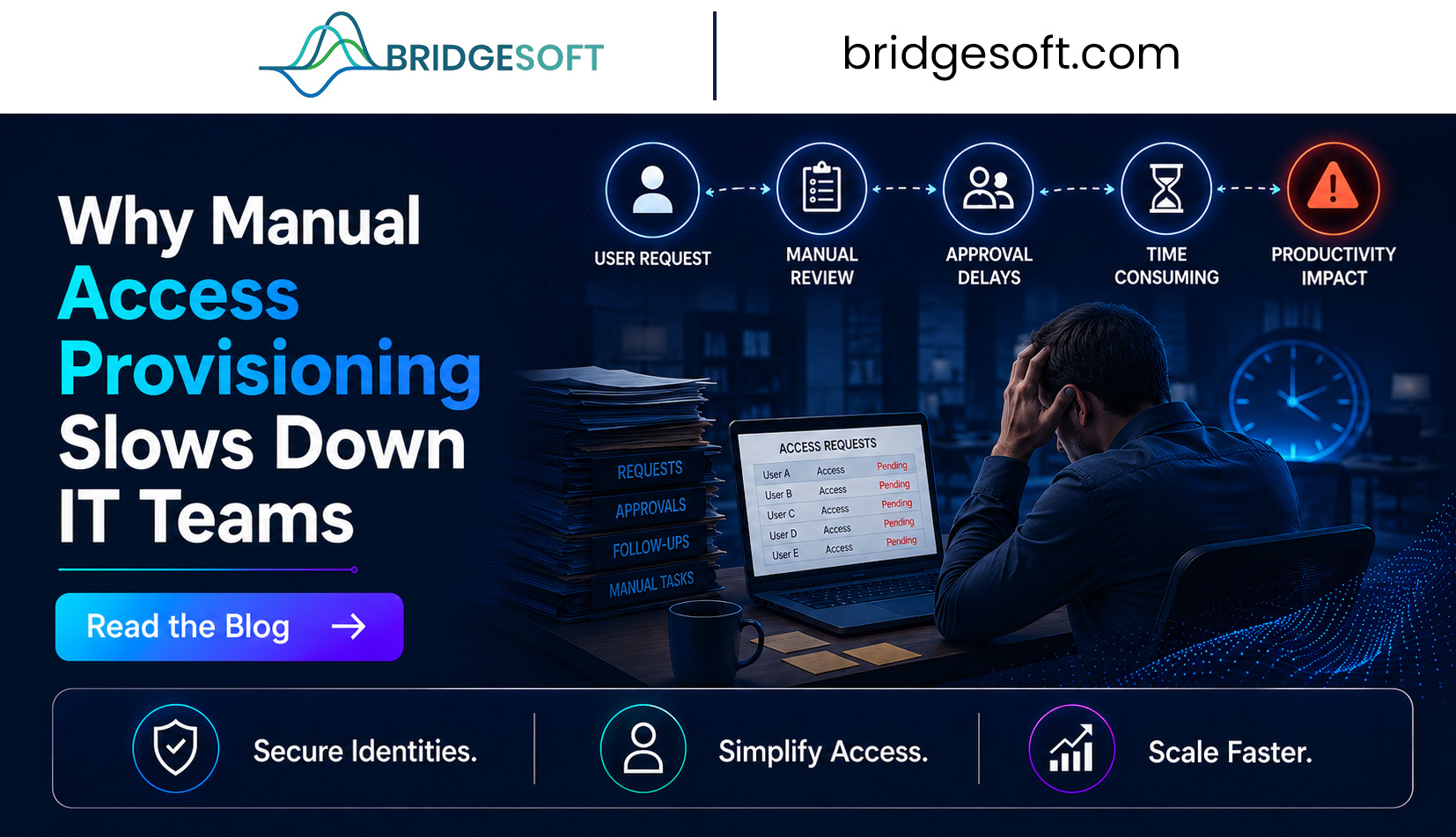
In many organizations, user access requests still follow a familiar pattern. A manager submits a request; the IT team reviews it; approvals are gathered via email or ticketing systems; accounts are created manually; permissions are assigned to applications one at a time; and confirmation is sent back to the user.
This process may seem straightforward, but it introduces delays at every stage. Waiting for approvals, switching between multiple systems, and manually configuring permissions consume valuable IT resources.
As organizations expand across cloud applications, hybrid environments, and remote workforces, these manual tasks multiply. IT teams spend more time managing access than supporting innovation, leaving little capacity for higher-value projects.
The Business Impact of Slow User Access Provisioning
Delayed access affects far more than the IT department. New employees who cannot access essential applications lose valuable onboarding time, while existing employees may experience interruptions when changing roles or joining new projects.
Business managers face productivity losses, employees become frustrated, and support tickets continue to increase. Over time, these inefficiencies affect collaboration, customer service, and overall business performance.
Manual provisioning also creates inconsistencies. Different administrators may assign different permissions for similar roles, leading to excessive access, missing permissions, or unnecessary approval requests. These inconsistencies increase operational complexity while making governance more difficult.
Faster user access provisioning improves both employee experience and business agility by ensuring users receive the right access when they need it.
Security Risks Associated with Manual Provisioning
Manual access management is not only inefficient—it also introduces security risks.
When access requests are processed manually, mistakes become more likely. Accounts may receive excessive permissions, access may remain active after employees leave the organization, or temporary privileges may never be removed.
These issues increase the organization’s attack surface and create opportunities for unauthorized access.
Strong, secure access management requires consistent policy enforcement throughout the identity lifecycle. Manual processes make this consistency difficult to achieve, particularly across large enterprises managing thousands of identities.
Automated identity controls reduce these risks by ensuring access decisions follow predefined security policies rather than individual administrative judgment.
How Role-Based Access Control (RBAC) Simplifies Provisioning
One of the most effective ways to reduce provisioning complexity is through Role-Based Access Control (RBAC).
Instead of assigning permissions individually, RBAC groups users according to their business roles. Employees in finance, human resources, sales, customer support, or IT automatically receive access appropriate to their responsibilities.
This approach dramatically simplifies provisioning because administrators no longer need to determine permissions for every request.
RBAC also improves consistency, reduces administrative effort, and supports compliance by ensuring similar roles receive standardized access across the organization.
As businesses grow, Role-Based Access Control becomes a critical foundation for scalable Identity and Access Management.
Accelerating IAM Deployment Through Automation
Organizations often view IAM deployment as a security initiative, but one of its greatest advantages is operational efficiency.
Modern IAM platforms automate the entire provisioning lifecycle—from onboarding and role changes to offboarding and access reviews. Instead of relying on emails, spreadsheets, or manual approvals, workflows automatically provision users based on business rules and organizational policies.
For example, when a new employee joins the company, the IAM platform can automatically create user accounts, assign applications, apply RBAC policies, notify managers, and trigger additional approvals where required.
Similarly, when employees change departments or leave the organization, access is automatically updated or revoked, reducing security risks and eliminating manual work.
Automation enables IT teams to focus on innovation instead of repetitive operational tasks.
Building a More Efficient IT Operation
Reducing manual provisioning is not simply about saving time—it is about enabling IT teams to operate more strategically.
Organizations that automate identity processes experience faster onboarding, fewer helpdesk requests, improved compliance readiness, and more consistent access controls. Employees gain quicker access to the tools they need, while administrators spend less time on routine requests.
A mature Identity Access Management strategy also improves visibility into user access across applications, making governance, auditing, and reporting significantly easier.
As organizations continue to adopt cloud technologies and expand digital operations, efficient identity management becomes a competitive advantage rather than simply an IT function.
[Best practice for successful access reviews]
Best Practices for Faster and More Secure Provisioning
Organizations looking to modernize User Access Provisioning should begin by evaluating existing access workflows and identifying manual bottlenecks.
Standardizing business roles through Role-Based Access Control (RBAC) helps eliminate inconsistent permissions and simplifies administration. Automating provisioning workflows ensures access is granted quickly while maintaining governance and compliance.
Integrating identity management across HR systems, directories, and enterprise applications further reduces duplication and improves operational accuracy.
Finally, organizations should regularly review provisioning performance, monitor approval timelines, and optimize workflows as business needs evolve.
Continuous improvement helps ensure provisioning remains both efficient and secure.
Final Thoughts
Manual provisioning may seem manageable in small environments, but it quickly becomes a barrier to productivity, security, and business growth as organizations scale.
The goal is not simply to provision users faster—it is to provide the right access, at the right time, with the right level of security.
Organizations that modernize their provisioning processes will build a more agile IT organization, improve employee experiences, and establish a stronger foundation for future digital transformation.
Ready to Modernize User Access Provisioning?
Manual provisioning shouldn’t slow down your IT team or business. Discover how automated Identity Access Management can simplify provisioning, strengthen Secure Access Management, and accelerate IAM deployment across your enterprise.
See how our Identity and Access Management solutions automate user access provisioning, implement Role-Based Access Control (RBAC), and help organizations deploy secure identity workflows faster.
#Bridgesoft #UserAccessProvisioning #IdentityAccessManagement #IAMDeployment #SecureAccessManagement #RBAC #RoleBasedAccessControl #IdentityManagement #AccessManagement #CyberSecurity #EnterpriseSecurity #Automation #DigitalTransformation #CloudSecurity #IdentitySecurity #UserProvisioning #Compliance #ZeroTrust #ITOperations #HybridCloud #IAM