In today’s fast-paced digital workplace, employees expect immediate access to the applications, systems, and resources they need to perform their jobs effectively. Whether organizations are onboarding new employees, managing contractors, supporting remote teams, or enabling third-party access, delays in user provisioning can negatively impact productivity, employee experience, and business operations.
At the same time, organizations must ensure that access is granted securely and consistently. Providing access too slowly can hinder business performance, while providing access too quickly without proper controls can introduce security risks and compliance concerns.
This is why User Access Provisioning has become a critical component of modern Identity Access Management strategies. The goal is no longer to create user accounts; it is to deliver the right access to the right users at the right time while maintaining security, governance, and operational efficiency.
Organizations that streamline provisioning processes gain a significant advantage by improving employee productivity, reducing administrative overhead, and strengthening their overall security posture.
The Cost of Slow User Provisioning
Many organizations still rely on manual provisioning processes that involve emails, spreadsheets, service desk tickets, and multiple approval steps. While these methods may have worked in the past, they often create bottlenecks in modern enterprise environments.
When user provisioning is delayed, employees may spend hours or even days waiting for access to critical applications. Productivity is impacted, onboarding is delayed, frustration rises, and IT workers are under more strain as a result.
Slow provisioning can also create security challenges. Inconsistent processes often result in excessive permissions, duplicate accounts, or delayed removal of access when users change roles or leave the organization.
As organizations continue expanding across cloud and hybrid environments, traditional provisioning methods become increasingly difficult to manage at scale.
Build a Strong Identity Access Management Foundation
Faster provisioning starts with a well-defined Identity Access Management framework. Organizations must establish a centralized approach for managing user identities, roles, permissions, and access requests across all systems.
A modern Identity Access Management platform provides visibility into user access, standardizes provisioning workflows, and enables automation across the identity lifecycle.
Organizations may reduce multiple processes and establish a uniform user experience across business systems, cloud platforms, and applications by centralizing identity management.
A strong IAM foundation not only accelerates access delivery but also improves governance, compliance, and operational efficiency.
Automate User Access Provisioning Workflows
Automation is one of the most effective ways to accelerate User Access Provisioning.
Manual provisioning requires IT teams to create accounts, assign permissions, configure access rights, and process approval requests individually. These time-consuming, repetitive operations increase the risk of human error.
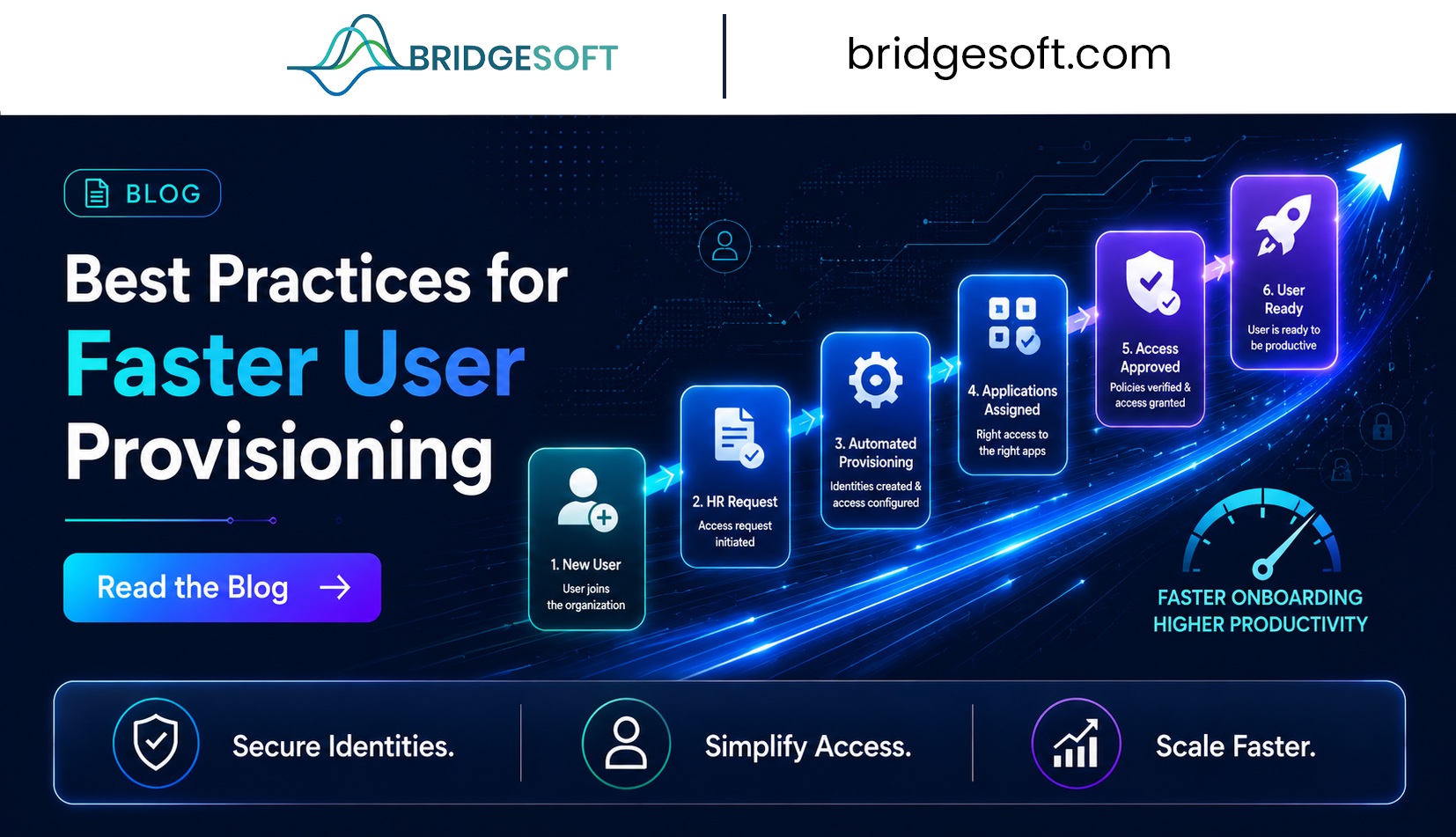
Organizations can add, edit, and remove user access in accordance with predefined business rules and policies through automated provisioning processes. When a new employee joins the company, access can be automatically assigned according to their department, role, location, or business function.
Automation helps organizations:
- Reduce onboarding delays
- Improve provisioning accuracy
- Minimize manual effort
- Enhance compliance
- Strengthen security controls
By removing manual bottlenecks, organizations can deliver access in minutes rather than days.
[AI for Identity vs Identity for AI]
Implement Role-Based Access Controls
One of the most common causes of provisioning delays is the lack of standardized access models.
Many organizations assign permissions manually, resulting in inconsistent access levels and lengthy approval cycles. Role-Based Access Control (RBAC) simplifies provisioning by grouping permissions into predefined roles aligned with business responsibilities.
Instead of assigning permissions individually, organizations can automatically grant access based on a user’s role.
For example, employees in finance, human resources, sales, or IT can receive access packages tailored to their specific responsibilities.
This approach not only accelerates provisioning but also supports Secure Access Management by ensuring users receive only the access necessary to perform their jobs.
Leverage an Identity Gateway for Centralized Access Control
As organizations expand across multiple applications and environments, managing access separately for each system becomes increasingly complex.
An Identity Gateway provides a centralized layer that connects users, applications, and identity services. It simplifies access enforcement, authorization, and authentication in both contemporary and legacy settings.
By leveraging an Identity Gateway, organizations can streamline provisioning workflows while maintaining consistent security policies across systems.
This centralized approach reduces administrative complexity and enables faster access delivery without compromising security or compliance requirements.
Strengthen Cloud IAM Security Through Automated Provisioning
Cloud adoption has transformed how organizations manage identities and access. Employees now require secure access to applications across multiple cloud environments, devices, and locations.
Without proper controls, cloud provisioning can become fragmented and difficult to manage.
Modern Cloud IAM Security solutions help organizations automate access management across cloud platforms while maintaining visibility and control. Automated provisioning ensures users receive appropriate access immediately while reducing the risk of excessive privileges or unauthorized access.
By integrating provisioning operations with cloud identity platforms, organizations can improve security consistency and accelerate digital transformation projects.
Simplify Approval Processes
User provisioning is frequently slowed down more by lengthy approval processes than by technical constraints.
Organizations should review access approval workflows regularly to eliminate unnecessary steps and streamline decision-making processes.
Automated approval routing based on predefined policies can significantly reduce delays while maintaining governance requirements.
When access requests are automatically routed to the correct stakeholders, organizations improve efficiency without sacrificing accountability.
Simplified approval processes help users gain access faster while reducing administrative burdens on managers and IT teams.
Continuously Monitor and Optimize Provisioning Processes
Fast provisioning is not a one-time achievement; it requires ongoing optimization.
Organizations should regularly evaluate provisioning performance by measuring:
- Access request completion times
- Approval cycle durations
- Provisioning accuracy
- User satisfaction
- Compliance outcomes
Continuous monitoring helps identify bottlenecks and opportunities for improvement.
As business requirements evolve, provisioning workflows should be updated to ensure alignment with organizational goals and security policies.
A proactive approach enables organizations to maintain both speed and security as their environments grow.
[What is Intelligent Identity Governance?]
The Business Benefits of Faster User Provisioning
Organizations that improve User Access Provisioning gain benefits that extend beyond operational efficiency.
Employees become productive faster, onboarding experiences improve, and IT teams spend less time managing repetitive administrative tasks. Automated workflows reduce human error, improve compliance readiness, and strengthen Secure Access Management practices across the enterprise.
Faster provisioning also supports business agility by enabling organizations to respond quickly to workforce changes, mergers, acquisitions, and digital transformation initiatives.
In an increasingly competitive business environment, efficient identity operations can become a meaningful strategic advantage.
Final Thoughts
User provisioning is one of the most visible and impactful components of modern Identity Access Management. When access is delayed, productivity suffers, security risks increase, and business operations become less efficient.
Organizations can accelerate User Access Provisioning by adopting automation, implementing role-based access controls, leveraging Identity Gateway technologies, and strengthening Cloud IAM Security practices.
The most successful enterprise’s view provisioning not as an administrative task, but as a strategic capability that supports security, user experience, and operational excellence.
By following these best practices, organizations can deliver faster, more secure, and more scalable access management across their digital ecosystems.
Ready to Accelerate User Provisioning?
Modern organizations need fast, secure, and scalable access management solutions. Discover how automated provisioning and intelligent identity management can transform your onboarding experience and strengthen enterprise security.
#Bridgesoft #UserAccessProvisioning #IdentityAccessManagement #CloudIAMSecurity #IdentityGateway #SecureAccessManagement #IAM #IdentitySecurity #AccessManagement #CyberSecurity #DigitalTransformation #SSO #MFA #CloudSecurity #EnterpriseSecurity #Automation #UserProvisioning #IdentityManagement #Compliance #ZeroTrust #HybridCloud